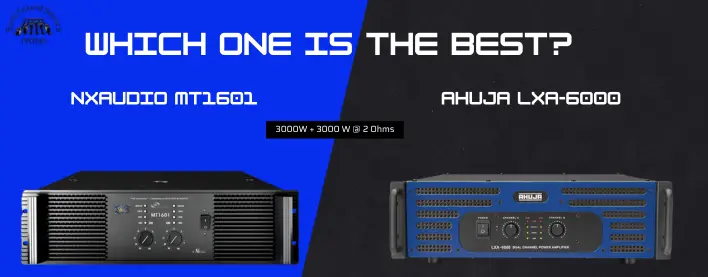
Both are high-power, Class H, dual-channel amps suited to touring/live PA, but the NXAudio MT1601 prioritizes a very high damping factor and sub-bass control, while the Ahuja LXA-6000 emphasizes protection, selectable input sensitivity, and a consistent spec sheet for power rating across 8/4/2 Ω with clear application cues.nxaudio+1
Choose MT1601 for tighter low-end control on large sub arrays and very high damping claims.audiomaxx+1
Choose LXA-6000 for balanced features, limiter, clear 2/4/8 Ω ratings, and robust protections in demanding PA duty.audiolx+1
NXAudio quotes damping “>1000” for MT1601 in official literature/catalog, indicating very low output impedance and strong cone control, particularly beneficial for long cable runs and big sub stacks; some vendor pages list 400–1000, but the brand catalogue explicitly calls out “Damping >1000 in MT1601.”djpundits+1
Ahuja specifies damping factor 400:1 at 8 Ω for LXA‑6000, which is solid for live sound and adequate for sub duty, though not as high as MT1601’s quoted figure; higher damping generally yields tighter bass if the rest of the chain (cabling, drivers) supports it.parasproaudio+1
MT1601 is commonly listed at 3000 W + 3000 W RMS @ 2 Ω, around 2250–2450 W + 2250–2450 W @ 4 Ω, and 1700 W + 1700 W @ 8 Ω, with bridge options 4200–5200 W depending on load; values vary slightly across resellers, but all position it as a 2 Ω-capable, high-current design.girijasoundsolution+1
LXA‑6000 is explicitly specified: 1300 W + 1300 W @ 8 Ω, 2000 W + 2000 W @ 4 Ω, 3000 W + 3000 W @ 2 Ω; bridged 4000 W @ 8 Ω and 6000 W @ 4 Ω, with power bandwidth rated 20 Hz–20 kHz at 0.5% THD, making it straightforward to match to loudspeakers and compliance targets.audiolx+1
MT1601 is a Class H live-sound amplifier; vendor pages frequently cite pro‑audio applications (stadiums, nightclubs, cinemas), and brand literature emphasizes component selection and high damping; published response ranges vary by reseller page, but positioning remains large‑venue reinforcement.nxaudio+1
LXA‑6000 specifies 20 Hz–20 kHz (−1 dB) and 20 Hz–20 kHz power bandwidth at 0.5% THD, plus 35 V/µs slew rate, aligning with full‑band PA duty and predictable HF behavior in arrays.parasproaudio+1
MT1601 references protection schemes and limiter/crossover features in reseller descriptions (e.g., SLDD processing, LX input overload limiter, high‑pass filtering, short‑circuit protection), which suit rental and touring rigs with varied loads; exact factory spec sheets are less centralized across pages.soundemporio+1
LXA‑6000 details temperature/DC/RFI/short‑circuit/overload protections, limiter ON/OFF, two selectable input sensitivities (0 dBu/4 dBu), variable‑speed fan cooling, and clear front‑panel indicators, making system integration and gain staging very predictable.audiolx+1
MT1601: excels driving large subwoofer arrays where cable runs are long and cone control matters; choose for bass‑heavy venues (clubs, festivals) where damping priority and 2 Ω stability are valued; also fits fixed installs seeking strong LF “grip.”audiomaxx+1
LXA‑6000: fits broad PA use—FOH and monitor duty—where known 8/4/2 Ω ratings, onboard limiter, and standard sensitivities simplify deployment across mixed inventories and contractors’ rigs.parasproaudio+1
Bass‑centric venues and long speaker lines: prioritize MT1601 for its very high damping and reputed sub control.nxaudio+1
Mixed PA inventory, predictable deployment, and bridged 4 Ω use with limiter control: pick LXA‑6000 for its clearly stated ratings and protections.audiolx+1
Both amplifiers are designed to run down to 2 Ω per channel and can be bridged; ensure speaker wiring maintains safe minimum impedance under parallel stacks, especially with dual 18ʺ subs in parallel per channel.audiomaxx+1
For bridged mode, verify the load presented is within the specified bridged ratings (e.g., LXA‑6000 supports 4 Ω bridged at 6000 W RMS); avoid wiring that drifts below the minimum, which increases thermal stress and protection trips.parasproaudio+1
For maximum cone control and sub impact, the MT1601’s higher quoted damping factor and stout current delivery are compelling.nxaudio+1
For clearly documented power rating at 8/4/2 Ω with robust protection and integration features, the LXA‑6000 is a safer standardization choice for large PA workflows.audiolx+1