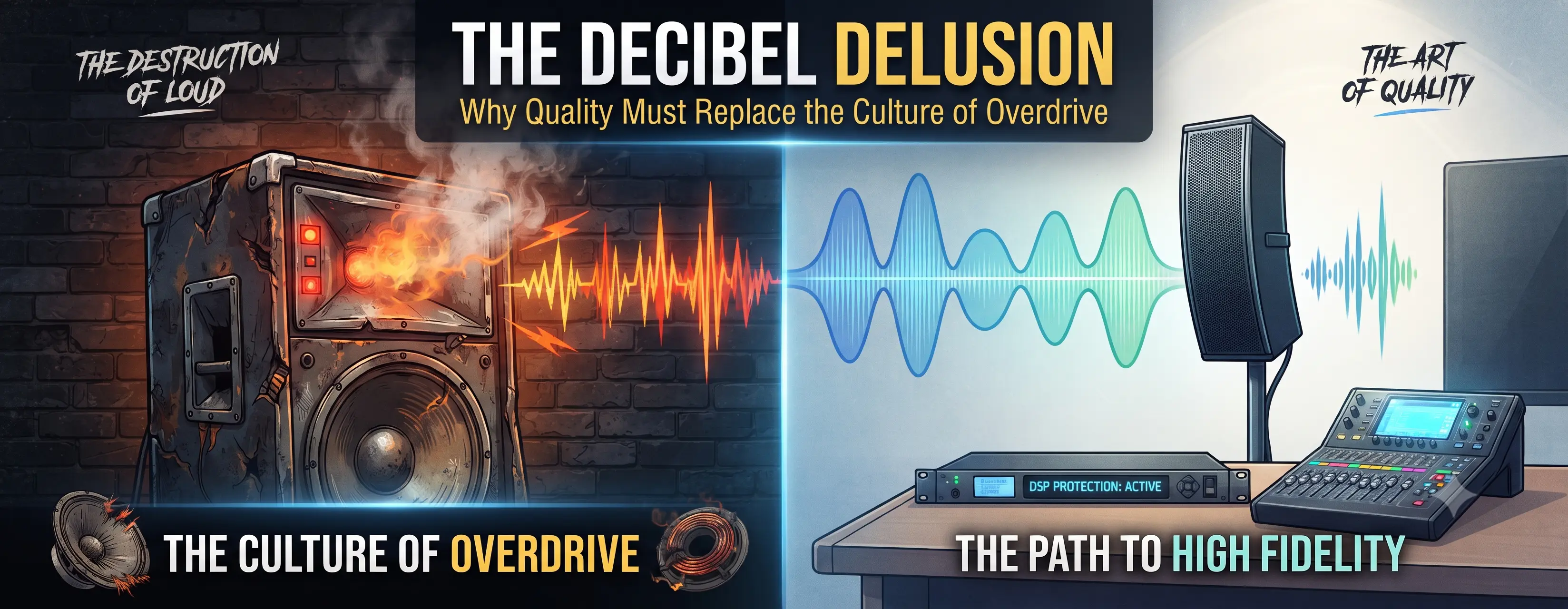
In the heart of our cities, a troubling trend has taken hold. As an audio retailer, I see it every day: a relentless, misguided obsession with "raw" volume. In many of our tier-2 and tier-3 markets, success isn’t measured by the clarity of the music or the fidelity of the sound, but by how many decibels a system can scream before it falls apart. This race to the loudest speaker, often fueled by reckless overdriving with high voltage, has become an expensive, unsustainable, and frankly, unethical practice.
But where does it actually end?
When we push an audio system beyond its design limits—forcing amplifiers to dump excessive voltage into drivers that weren’t built to handle it—we aren’t creating power. We are creating destruction. Physics doesn't negotiate; when you overdrive a system, you are simply accelerating its failure. The result is a cycle of burnt voice coils, fractured diaphragms, and permanent damage to crossover networks. For the average operator, this turns a professional tool into a "disposable" asset that bleeds money through constant, avoidable repairs. It is a cycle of "penny wise, pound foolish" that costs more in the long run than investing in quality gear in the first place.
The tragedy is that this doesn't have to be the standard. We are missing the "brain" of the operation: the Digital Signal Processor (DSP), like the DPA 230 or dbx 360. In many parts of Bihar, these tools are ignored, yet they are the most critical components for system longevity. A DSP acts as a guardian, using limiters to set a ceiling that protects your hardware from the voltage spikes that kill equipment. It also allows us to tune a system to the specific acoustics of a room, creating a balanced, professional sound rather than a muddy wall of noise.
The same applies to the shift toward digital mixers. Far too many are still relying on analog setups that leave them unable to control individual channels with precision. Digital mixers aren't just about "fancy features"; they are about clean, surgical control—allowing you to compress vocals, carve out harsh frequencies, and save perfect settings for specific venues.
True high-quality audio isn't about how much punishment a speaker can take; it’s about headroom, clarity, and the faithful reproduction of sound at a sustainable level. It is time we stop being "box sellers" and start being sound professionals. It is time to stop selling decibels and start selling quality. We have a responsibility to show our clients that a properly tuned, protected, and balanced system will not only sound better but will outlast any "overdriven" trolley ten times over.
The loudest system is rarely the best one. Let’s stop chasing the noise and start respecting the art of sound.